Victoria’s legislative and regulatory landscape for the electrical industry has seen significant change in recent months, including:
- The enactment of the Energy and Land Legislation Amendment (Energy Safety) Act 2025
- Updates to ESV’s Requirements for the Effective Supervision of Apprentice Electricians
With so much to navigate, we’ve prepared this document to clearly outline the key amendments affecting you, along with the advocacy MEA has undertaken to support our members and the wider industry in Victoria.
Regulatory Amendments
Energy and Land Legislation Amendment (Energy Safety) Act 2025
Below is an overview of key changes to the Energy and Land Legislation Amendment (Energy Safety) Act 2025 which will affect Registered Electrical Contractors (RECs) and Licensed Electrical Workers (LEWs).
For further details, please visit ESV’s website here.
| Effective as of May 2025 (already in action!) |
| CHANGE | OVERVIEW |
|---|---|
| Increased Penalties | ESV penalties for RECs and LEWs have significantly increased.
An overview of the updated penalties, including relevant sections of the Act and penalty point amounts, is available here. The additional reference material below is available: |
| Immediate Suspensions | ESV now has the power to immediately suspend, in full or in part, the registration of a REC or the licence of a LEW.
This will only occur when:
Examples of conduct that may trigger immediate suspension are available here. The suspension may be revoked at any time. RECs and LEWs may apply to the Tribunal to have the decision reviewed. |
| Injunctions | Energy Safe can apply to the court for an injunction to prevent a person engaging in conduct that constitutes or would constitute a contravention of the Electricity Safety Act, the Gas Safety Act or associated regulations. |
| Adverse Publicity Orders | Energy Safe can apply to the court to make an order requiring a person who is convicted or found guilty of an offence to disclose or publicise information about their offending conduct. |
| Specified Operator Bushfire Mitigations Plan Changes | Specified operators of at-risk electric lines (excluding major electricity companies) must now submit bushfire mitigation plans to Energy Safe at least every five years, instead of annually. |
| Effective as of 1 April 2026 |
| CHANGE | OVERVIEW |
|---|---|
| Prohibition Notices | Energy Safe’s Chairperson or authorised officers will be able to issue a prohibition notice under the Electricity Safety Act to stop an activity that is creating an immediate safety risk. |
| Enhanced Authorised Officer Powers |
|
| Terminology Updates | References to ‘enforcement officer’ in the Electricity Safety Act and ‘inspector’ in the Gas Safety Act will be changed to ‘authorised officer’ for consistency. |
Effective Supervision of Apprentice Electricians
Effective from 1 September 2025, an amended version of the Requirements for the Effective Supervision of Electrical Apprentices (the Requirements) will come into force. All Victorian electrical business owners, supervisors, and apprentices must comply. om
Key Changes
The amended Requirements, released by Energy Safe Victoria (ESV), include the following updates:
- Supervision Ratios Tightened: Stricter limits have been introduced on how many apprentices a supervisor can oversee.
- Clarification on Scope: Emphasis that supervision ratios apply only to electrical installation work. Routine tasks such as moving equipment or trench digging are excluded.
- Direct Supervision Levels Defined by Risk:
- High-risk tasks require direct visual and audible supervision.
- Lower-risk tasks can be directly supervised within audible or visual supervision.
- Refer to Requirements for the effective supervision of apprentice electricians | Energy Safe Victoria for further clarification on what direct supervision tasks are classified as high and low risk tasks.
- Supervisor Competency: Retained that supervisors must be competent in the specific work being undertaken by the apprentice (i.e. a supervisor overseeing an apprentice installing solar panels must have expertise in installing solar panels)
- Access to the Requirements: Employers must ensure all supervisors have access to either a digital or printed copy of the Requirements.
- Training Contracts: Employers must confirm that each apprentice has a valid training contract in place.
Apprentice Empowerment
Importantly, the revised Requirements formally recognise the role and responsibilities of electrical apprentices. In particular, apprentices have the right to refuse work if they have reasonable concerns about the adequacy of their supervision.
Updated Supervision Ratios
See the Table 1 below for a comparison between the current supervision ratios and the new ratios effective from 1 September 2025:
Table 1: Supervisor: Apprentice Ratio Levels
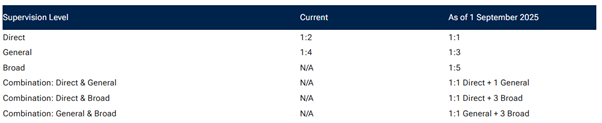
ESV has emphasised these ratios are only applicable to electrical installation work, and they may demonstrate tasks to multiple apprentices at once and make use of peer observation.
Moving up Supervision Levels
As under the existing requirements, the revised version adopts a model based on both time and competency.
Refer to Table 2 for the minimum requirements for an apprentice being supervised at each level. It is the responsibility of the supervisor to assess whether the apprentice is also competent to progress to the next level of supervision, in addition to meeting the minimum time requirement.
Table 2: Levels of supervision for specified types of electrical installation work
Refer to Table 2 for the minimum requirements for an apprentice being supervised at each level. It is the responsibility of the supervisor to assess whether the apprentice is also competent to progress to the next level of supervision, in addition to meeting the minimum time requirement.
Table 2: Levels of supervision for specified types of electrical installation work
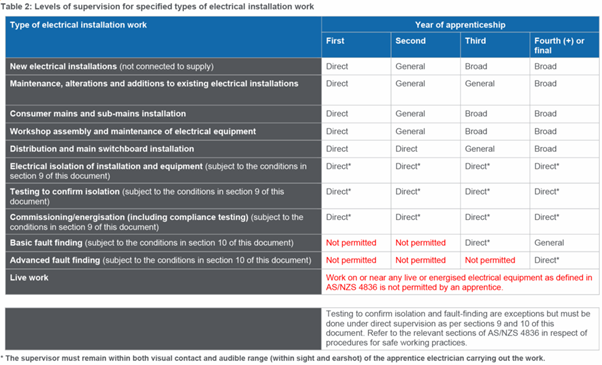
Fault-finding has now been split into two categories: basic and advanced.
- 1st and 2nd-year apprentices remain prohibited from performing any fault-finding tasks, regardless of supervision.
- 3rd-year apprentices are not permitted to perform advanced fault-finding, even under supervision.
- Basic fault-finding may be performed by 3rd-year apprentices but only under direct supervision, with both audible and visual proximity.
- 4th year apprentices are permitted to perform both fault finding tasks under direct supervision, with both audible and visual proximity.
MEA’S Advocacy
Meeting with Member of Parliament: Mr David Limbrick MP
MEA recently met with David Limbrick MP, who raised several key concerns in Parliament on behalf of Master Electricians Australia. The following matters were brought to the attention of Parliament:
- Apprentice Retention in Small Businesses
Labour competition with large government and private sector projects; especially the risk of losing 3rd and 4th year apprentices thereby disincentivising small and medium businesses from training apprentices. - Continued Professional Development (CPD)
The ongoing requirement for face-to-face CPD imposes unnecessary costs on small businesses, particularly when the same outcomes can be achieved through online delivery. - Supervision Ratios
Recently introduced supervision ratios are overly restrictive and place additional burden on employers . - Licensing Reform
Proposed licensing reforms under the Energy Safety Review risk duplicating existing systems, particularly given the role of Solar Accreditation Australia. - Energy and Land Legislation Amendment (Energy Safety) Act 2025
MEA has called for updated guidance on the new powers and penalties introduced under the Act to ensure clarity and compliance across the industry. - MEA Submission to the Energy Safety Review
Requested that Parliament give due consideration to MEA’s formal submission as part of the Energy Safety Review process.
We thank Mr Limbrick for raising these matters on our behalf.
You can read the full dialogue in Parliament here.
Energy Safety Review
Master Electricians Australia recently responded to the Victorian Government’s Energy Safety Review consultation, informed by feedback from our members.
Our submission addressed several key issues, including:
- Continued Professional Development (CPD)
- Licensing and accreditation frameworks
- Apprenticeship supervision ratios
- Free access to Australian Standards
- Increased penalties under the Energy and Land Legislation Amendment (Energy Safety) Act 2025
- Unlicensed installation activity
- Broader workforce development
You can read our full submission here.
Energy and Land Legislation Amendment (Energy Safety) Act 2025
MEA acknowledges the importance of strong safety regulations. However, we are concerned that the volume and pace of recent legislative changes may lead small contractors to inadvertently overlook key amendments.
To address this, MEA has called for clearer guidance on the increased penalties and ESV’s expanded powers (particularly around right-of-entry provisions and the ability to immediately suspend licences) which may have significant implications for small electrical businesses.
We will continue to advocate on behalf of our members and the broader electrical industry, and we thank Mr Limbrick MP for raising these concerns in Parliament.
Supervision Ratios
Since early 2024, MEA has been actively engaged with ESV on the upcoming amendments to supervision requirements for electrical apprentices. We made it clear that MEA does not support more restricted supervision ratios. Instead, we advocated for a competency-based framework, similar to Queensland’s model, which allows supervisors the flexibility to assess apprentices primarily based on their capabilities, rather than being restricted by the amount of time the apprentice has spent in training.
Our advocacy has focused on the impacts on small businesses as well as the broader skills shortages.
MEA strongly opposed the tightening of supervision ratios and advocated instead for:
- A greater focus on training supervisors, to avoid the rise of “accidental supervisors” without proper preparation.
- A system that does not disadvantage small businesses, which often lack the resources to meet rigid ratio requirements.
After reviewing our concerns, ESV concluded:
- Most small businesses are unlikely to be significantly impacted by the new ratios based on current apprentice enrolment trends.
- Tighter supervision may actually improve apprenticeship completion rates, as apprentices gain more meaningful supervision and experience.
They also responded to our request for a cost-benefit analysis, noting that while a quantitative assessment was not conducted, their investigations found costs to small businesses will be minimal.
Future Opportunities in the Supervision Space
MEA called for the development of a competency guideline to assist supervisors and PCBUs in making informed decisions about when apprentices are ready to progress to relaxed levels of supervision (in addition to table 1 being complied with). While this guideline has not been drafted, ESV has acknowledged the value of this recommendation and are open to progressing it further.
MEA continue to advocate for the new supervision requirements to be revised.